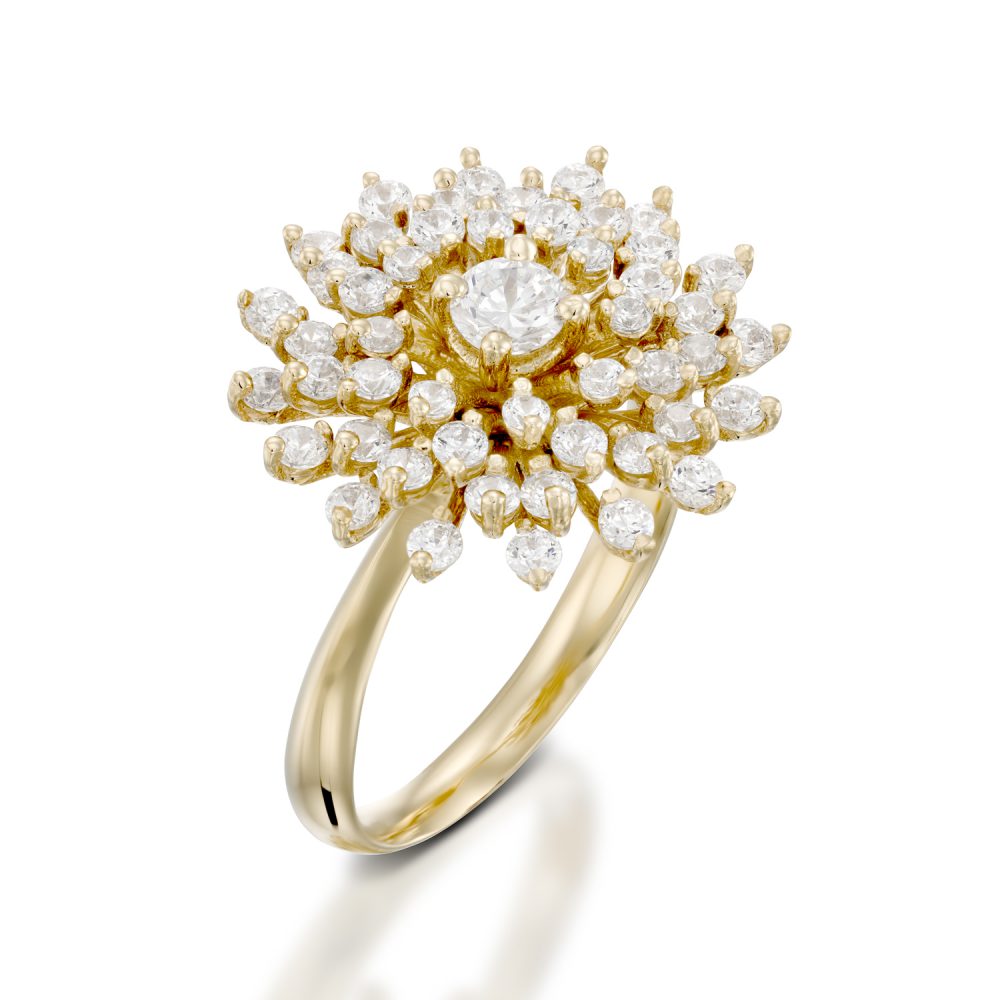
A lab-grown diamond is the same diamond. The same material, the same chemical formula, the same brilliance. But it is created in a lab within a few weeks, rather than over billions of years in the earth. Here is what a lab-grown diamond is and how it compares to a natural one.
On this page
- What is a lab-grown diamond?
- How it is made, two methods
- Comparison table: lab-grown vs. natural diamond
- Pros and cons
- Is it a “real diamond”?
- Price and what’s worth knowing
- How to identify a lab-grown diamond
- When to choose lab-grown and when natural
What is a lab-grown diamond?
A lab-grown diamond (LGD) is a real diamond, identical in chemical, physical, and optical structure to a natural diamond. Both are made of crystalline carbon. The only difference is the origin: a natural diamond forms deep within the earth over billions of years, while a lab-grown diamond is created in a lab within a matter of weeks.
How is a lab-grown diamond made?
Two common technologies, both requiring advanced science:
HPHT, high pressure and high temperature
Mimicking the natural conditions deep within the earth: immense pressure (over 50,000 atmospheres) and a temperature of 1,500°C. A small carbon seed grows into a full diamond within a few weeks. This is the older method.
CVD, chemical vapor deposition
The modern method. A carbon-rich gas (methane) is released into a chamber, and carbon atoms are layered one upon another onto a small diamond seed. It grows slowly and precisely, producing especially pure crystals.
In both methods, the carbon ultimately arranges into the same crystalline structure as a natural diamond. That is why an optical test cannot distinguish between the two, it requires specialized professional instruments.
Comparison table
Natural and lab-grown diamonds are more alike than they seem. Here are the differences, and the similarities:
| Parameter | Natural diamond | Lab-grown diamond |
|---|---|---|
| Chemical composition | Crystalline carbon (C) | Crystalline carbon (C), identical |
| Hardness (Mohs scale) | 10 out of 10 | 10 out of 10, identical |
| Brilliance and appearance | Identical | Identical |
| Rarity | Very rare | Can be produced on demand |
| Creation time | 1-3 billion years | 2-8 weeks |
| Price | “Full” | Significantly lower |
| Resale value | Retains its value | Lower value in most cases |
| Certification | GIA, IGI, etc. | GIA, IGI (marked “Lab-Grown”) |
| Environmental impact | Targeted mining | High electricity consumption |
Pros and cons
Pros
- A real diamond at a far lower price
- You can get a larger diamond for the same budget
- No concern over “blood diamonds” or conflict zones
- Cleaner diamonds (fewer inclusions)
- Ability to match size and color to demand
- Optically identical to a natural diamond, no one will notice
Cons
- Lower resale value
- Not “rare”, can be produced in quantity
- Lacks the “magic” of billions of years in the earth
- High electricity consumption in the process
- A relatively new market, demand less predictable
Is it a “real diamond”?
This is the most important question, and the answer is yes. A lab-grown diamond is a real diamond, this is what the FTC (the U.S. regulator) officially ruled in 2018. It meets every criterion a diamond must meet: material (carbon), hardness, brilliance, and the ability to be cut and polished.
The origin is the only difference, and it does not change what the stone is: a lab-grown diamond is a diamond.
Price: The Big Difference
Price is the biggest practical difference. Lab-grown diamonds generally let you get a larger or higher-quality diamond for a given budget, at a price significantly lower than a natural diamond with similar characteristics. The price varies by carat weight, color, clarity, cut, and certification. For an up-to-date price for the diamond that suits you, contact us and we will be happy to prepare a quote.
How do you identify a lab-grown diamond?
With the naked eye, you can’t. No jeweler can tell with the naked eye. It requires:
1. A certificate: every lab-grown diamond comes with a certificate from GIA, IGI or a similar lab, bearing the inscription “Laboratory-Grown Diamond”.
2. Specialized instruments: FTIR and Raman spectroscopy devices detect signs of artificial growth.
3. Microscopic engraving: lab-grown diamond makers engrave a tiny mark on the edge of the diamond (visible only under magnification) indicating its origin.
When to choose lab-grown and when natural?
A lab-grown diamond is right if:
you want a large diamond on a limited budget, you care about environmental/ethical issues, or you want a cleaner stone for the same price.
A natural diamond is right if:
you see the piece as a long-term investment, a “story” and rarity matter to you, or you plan to pass the piece down as an heirloom.
Want to consult before deciding?
Come to our factory store in Kfar Chabad: we have samples of lab-grown and natural diamonds in the same size. You can see and decide without pressure. WhatsApp · 03-9601463