You bought a secondhand piece of jewelry, inherited one, or you’re simply not sure if what you have is real gold. Before you seek professional testing, there are a few simple tests you can do at home without special equipment. They don’t replace professional testing, but they’ll give you a good indication before you invest money or sell a piece of jewelry.
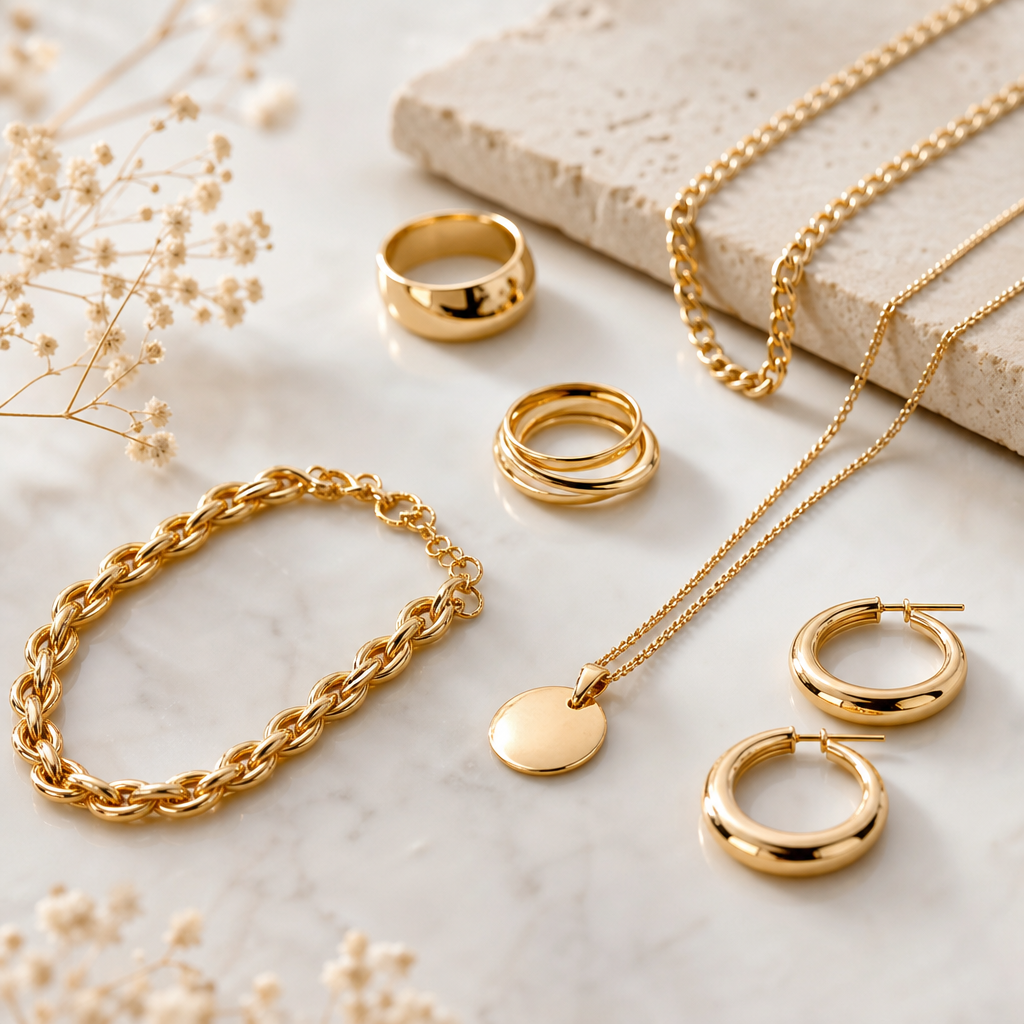
What is considered real gold?
Pure gold is too soft for jewelry, so almost every piece is made from an alloy: gold mixed with other metals that give it strength and tone. “Real gold” means the gold content matches the hallmark on the piece, such as 585 or 750. Gold-plated jewelry, on the other hand, is inexpensive metal with a thin layer of gold on the surface, and its value is much lower.
Gold Hallmark Table: Karat vs. Purity
The hallmark indicates the percentage of pure gold in the jewelry:
| Hallmark | Karat | Gold percentage |
|---|---|---|
| 375 | 9K | 37.5% |
| 417 | 10K | 41.7% |
| 585 | 14K | 58.5% |
| 750 | 18K | 75% |
| 875 | 21K | 87.5% |
| 916 | 22K | 91.6% |
| 999 | 24K | 99.9% |
The higher the karat, the more gold in the piece, and the more expensive it is. But higher isn’t always better for everyday wear: high-purity gold is relatively soft and tends to scratch and bend. That’s why 14K and 18K are the popular choice for jewelry worn daily: they combine a rich appearance with durability.
Test 1: Purity Hallmark
This is the first test. Almost every real gold piece bears a tiny hallmark in an inconspicuous spot: on the inside of a ring, on the clasp of a necklace, or on the back of an earring. Use a magnifying glass or your phone camera’s zoom.
Important to know: Numerical markings like 585 or 750 are considered clearer, but even a hallmark isn’t absolute proof. Complete absence of a hallmark is a sign that requires testing.
Test 2: Magnet Test
Real gold is not attracted to a magnet. Bring a strong magnet close to the jewelry. If the piece is attracted to the magnet, it’s a clear warning sign that the piece contains other metals, or that only part of it is actually gold. Note that this test can only rule gold out: fakes based on copper or brass won’t react to a magnet either, so a normal result still isn’t sufficient proof.
Test 3: Color and Wear
Real gold doesn’t corrode the way base metals do, and generally maintains a stable appearance over time. Check the areas that rub against skin, like the inside of a ring or the back of an earring. If a different tone appears there, grayish or reddish, it may be gold plating that has worn off, exposing the metal underneath. The color of solid gold tends to be uniform and warm, while worn plating looks flat and dull.
Test 4: Weight and Density
Of the home tests, this is the one that comes closest to a real measurement. Weigh the piece, place it in a glass of water, and measure how much water is displaced: this is the volume. Divide the weight by the volume to get density. For comparison: pure gold is about 19.3 g/cm³, 18K around 15.5, and 14K around 13. Gold is very heavy relative to its size, and fakes made of light metal will behave differently.
In practice, this test isn’t always accurate for jewelry with stones, hollow spaces, links, or complex shapes.
Test 5: Vinegar (Use with Caution)
Place a drop of vinegar or lemon juice on a small spot on the piece. Real gold generally shouldn’t change color from brief contact with household vinegar, but the test isn’t definitive and isn’t suitable for delicate jewelry. Don’t soak the piece in vinegar and don’t leave it immersed for a long time: prolonged acidity can damage stones or other metal parts.
Remember, home testing provides only an indication
None of the five tests provides complete certainty. Each tests a different aspect, and it’s worth cross-checking several of them to get a more reliable picture. If something doesn’t add up, or if it’s an expensive piece, it’s time for professional testing.
Tests you shouldn’t do at home
There are tests circulating online that can damage your jewelry. Avoid them:
- Don’t scratch the piece on ceramic or a touchstone
- Don’t heat it with fire or flame
- Don’t use strong acids
- Don’t file or damage the surface
- Don’t cut the piece to see inside
All of these can leave irreversible marks and damage the piece’s value. When in doubt, a non-invasive test by a professional is always better.
Professional XRF testing at Gindi Gold in Kfar Chabad
At Gindi Gold in Kfar Chabad, you can have professional gold testing done with an XRF device. The test identifies the metal composition reliably, without damaging the jewelry: no filing and no cutting. It’s especially suitable for heirloom jewelry, pieces without hallmarks, secondhand purchases, selling gold, or when home test results are unclear.
The reading shows the exact metal composition at each tested spot, something no home test can tell you.
FAQ
What does a 585 hallmark mean?
The piece is made of 14-karat gold, meaning 58.5% pure gold and the rest alloy metals.
Is real gold attracted to a magnet?
No. Gold is not magnetic. If the piece is attracted to a magnet, it’s a suspicious sign that it contains another metal.
Does the vinegar test prove it’s real gold?
No. It provides only an indication and isn’t definitive, and it’s not a substitute for professional testing.
What’s the difference between 14K and 18K?
18K has more pure gold (75% vs. 58.5%), so it’s more expensive and has a richer, warmer tone. 14K is more resistant to scratches and everyday wear. You can also read more about the difference between yellow, white, and rose gold.
Does XRF testing damage the jewelry?
No. The test is non-invasive, doesn’t file or cut: the piece comes out exactly as it went in.
Want to test a piece of jewelry?
Bring your piece to us in Kfar Chabad and we’ll test it with an XRF device, with no damage to the jewelry. We’ll be happy to test your piece, explain the results clearly, and give you transparent advice before selling, buying, or making a decision. To schedule a test, contact us via WhatsApp or phone: 03-9601463.