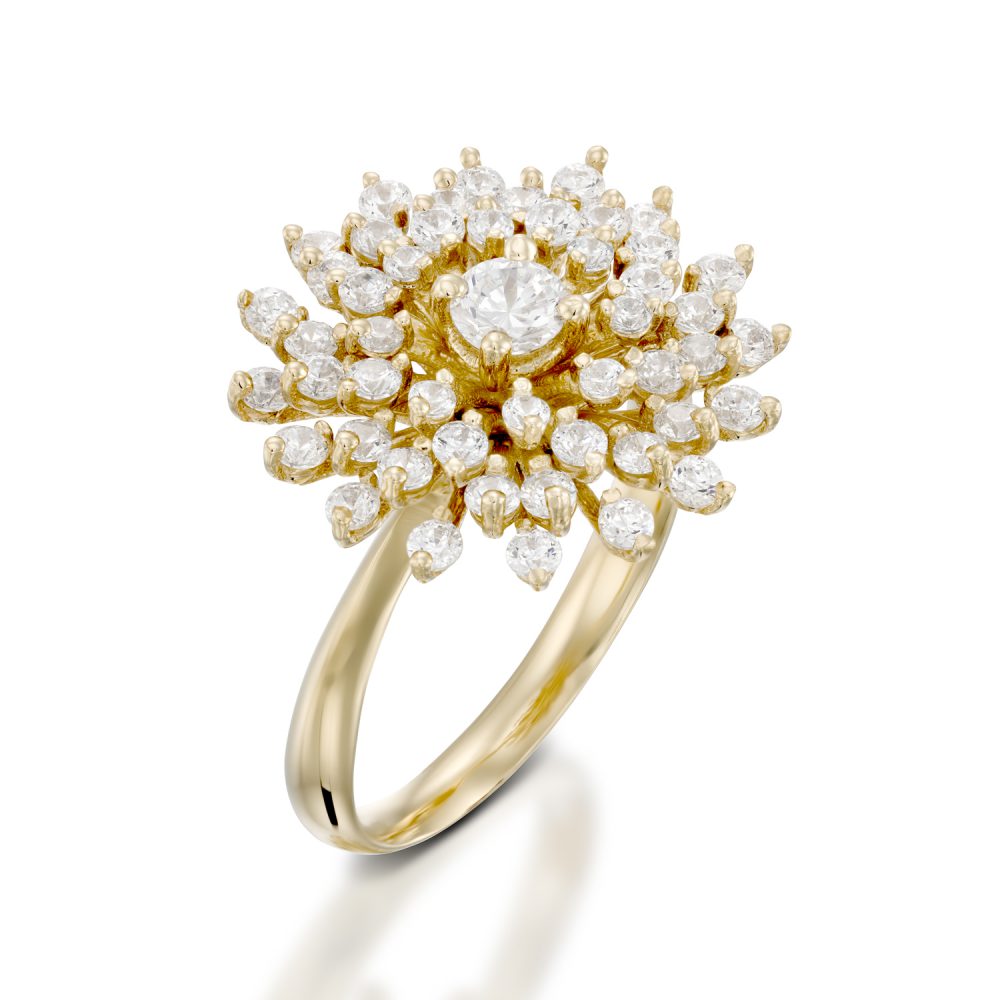
The diamond: the hardest gemstone in the world, and a timeless symbol of love. But what actually makes one diamond more beautiful than another? Here is the complete guide to understanding the diamond: its history, and the 4 Cs quality criteria.
On this page
- What is a diamond?
- History and symbolism
- The 4 Cs: diamond quality criteria
- Gem diamonds vs. industrial diamonds
- Tips for choosing a diamond
What is a diamond?
The diamond is the hardest natural material known to man, composed entirely of crystalline carbon. Under extreme pressure and temperature, deep in the Earth’s mantle, the carbon crystallizes and gives birth to the diamond.
Unlike other gemstones, the diamond is made of a single element, which makes it the purest of gems. Its ability to return light in a unique way, like tiny fireworks, comes from its internal crystal structure.
History and symbolism
Diamonds were first discovered in India, about 2,500 years ago. In ancient Greece, the diamond was a classic symbol of love. For generations people believed diamonds were formed from hardened dew drops, from fragments of stars, or from lightning that crystallized into stone.
Today, the diamond is the stone of choice for an engagement ring: a symbol of beauty, permanence, and promise. Beyond that, diamond jewelry is considered a long-term investment and an heirloom piece.
The 4 Cs: Diamond Quality Criteria
To evaluate a diamond, the professional world uses four measures, each beginning with the letter C. Get to know them before you buy.
Carat, weight
The carat is the diamond’s unit of weight (1 carat = 0.2 grams). A larger diamond is more expensive, but not always more beautiful: the other characteristics matter just as much.
Cut
The cut determines how light “plays” in the diamond. An excellent cut creates a mesmerizing sparkle; a poor cut leaves a diamond that looks pale and dull.
Color
An ideal neutral diamond has no color at all (grade D). As you move down the scale, from D to Z, a subtle yellowish tint appears. Two diamonds of the same carat can look very different because of color.
Clarity
Most diamonds contain tiny inclusions (internal flaws). Clarity is graded from IF (flawless) to I3 (flaws visible to the eye). Higher clarity = a more expensive diamond.
Gem diamonds vs. industrial diamonds
Gem diamonds are used for fine jewelry and engagement rings. They have been carefully selected by the 4 Cs and given a delicate, precise cut.
Industrial diamonds are diamonds that are not beautiful enough for jewelry, but their hardness is still useful, so they are used for cutting, drilling, and polishing other materials. In fact, most diamonds found in nature go to industrial use, and only a small percentage become fine jewelry.
Tips for choosing a diamond
1. Set a budget first. A diamond can range in price from hundreds of shekels to tens of thousands. Setting a budget in advance helps you focus on the right options.
2. Ask for the gemological certificate. Leading labs such as GIA and IGI officially grade diamonds from 0.15 carat. For any significant purchase, ask for an official certificate detailing the 4 Cs: it guarantees an objective, transparent assessment of the diamond’s quality.
3. Ask to see it with your own eyes. Photos do not capture how light behaves in a diamond. It is always better to see it in person.
4. Trust your jeweler. A true professional will steer you to the best choice within your budget, not to the most expensive option.
Interested in diamond jewelry?
We would be glad to advise you personally. Browse our diamond collection or contact us on WhatsApp · 03-9601463